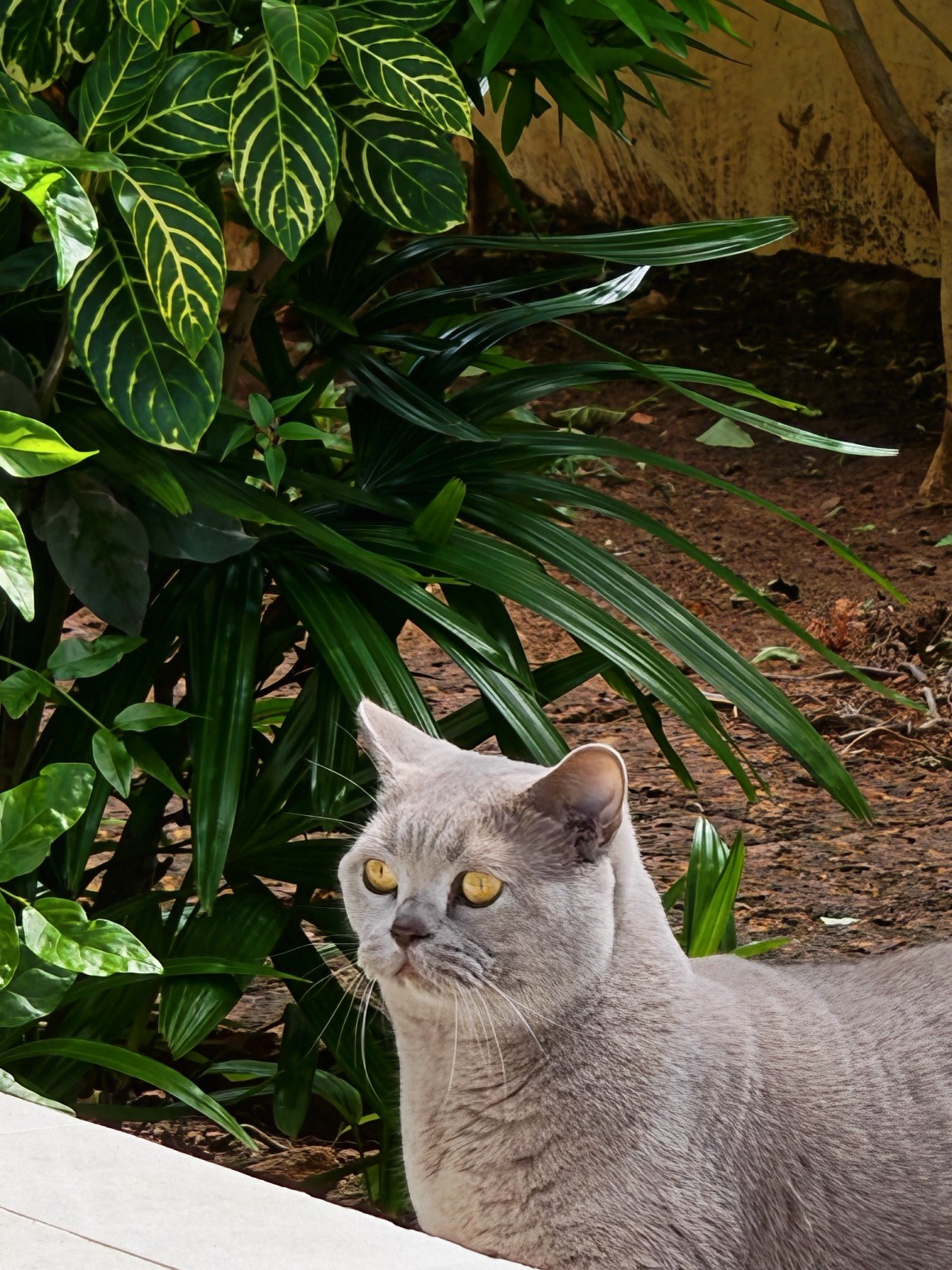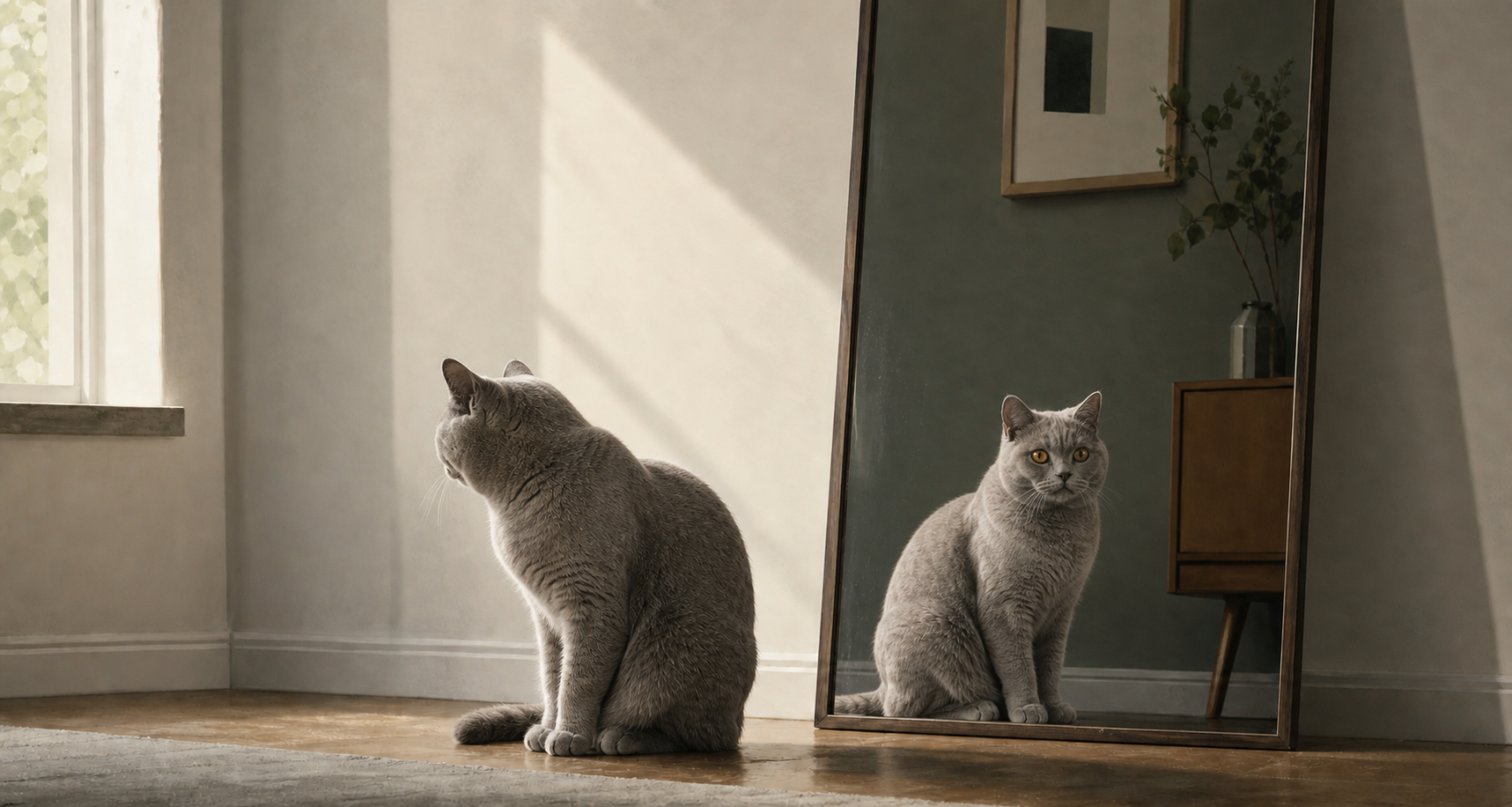
The Cat in the Mirror
I know my cat Noriko notices the mirror, because he tends to strategically avoid it. If we shift the mirror so he can see himself, he moves to a different location. If I wave at him through the mirror, he turns around and looks directly at me. On some level he knows how the mirror works.
He is also not surprised by the mirror. It is a familiar piece of furniture in his world. He doesn't react as if there was another cat in the mirror. There is no fear or hostility towards the mirror. The attitude might better be described as one of deliberate and strategic ignorance.
The cat cannot avoid seeing the reflection, but he does not know what to do with it. His response seems to be: enough of this nonsense. Look away and attend to something useful.
Two Skepticisms
This is not really about my cat. Any intelligent creature can ignore, neglect, deny, or rationalize what lies too far beyond its ability to understand. In such situations, the brain may not even register a difficult problem. It may simply dismiss it as nonsense that can safely be ignored.
Many people today are proud of being skeptical. It is true that there is a disciplined skepticism that protects thought from credulity. There is also an animal skepticism: a practical dismissal of whatever offers no smell, touch, food, threat, or immediate use. When Noriko looks at the mirror, he seems skeptical in this sense.
In general, the natural tendency is to be skeptical of looking at something simply to appreciate it, or thinking about it without a practical aim: of aesthetic disinterestedness or theoretical thought. Why pay attention to something without obvious benefit or practical purpose? Often this caution is justified: such pursuits can be foolish, even dangerous. Yet staying with something strange long enough to understand it is also among our most advanced capacities. Keats called the capacity to remain with uncertainty "negative capability":
"when a man is capable of being in uncertainties, mysteries, doubts, without any irritable reaching after fact and reason" John Keats, letter to George and Thomas Keats, December 1817
Philosophy and Reality
The unsettling thing is not just the difficulty of a given problem, like identifying oneself in a mirror. A person can fail to solve a difficult problem without feeling threatened by it. A problem becomes psychologically unsettling when it disturbs our self-image, our image of others, our view of the world, or the relations among them. Some fields of inquiry raise questions of this kind more directly than others. Philosophy is one of them.
Moral and political philosophy touch our self-image and sense of purpose. They ask what we should do and what kind of creature we are. The bias is toward answers that protect our self-image, commitments, and sense of purpose. Because these questions make a practical difference, people become animated, take sides, and fight for a cause.
In theology and metaphysics, we ask more abstract questions about the nature of the world itself. Is reality purposive or indifferent? Is mind fundamental or accidental? These questions can disturb the background against which our moral commitments, practical concerns, and even our lives make sense.
Explaining Away
The cat's difficulty is not simply that he sees an image. Whenever he moves, the cat in the mirror moves with him, but there is no other animal there to smell or touch. Perhaps recognizing himself is only part of the difficulty. The reflection offers him no obvious use, and making sense of it may unsettle his familiar picture of the world. So the cat simply ends the problem by looking away.
Human beings do the same under more respectable names. In philosophy we may call something "merely abstract," "just metaphysics," "wordplay," "mysticism," "nonsense," "unfalsifiable," or "impractical." That judgment is sometimes correct, but it can also become a way of refusing the question before we have understood it, and in that case it becomes ignorance, neglect, denial and rationalization.
Noriko looks away. We do the same when facts or arguments challenge our beliefs. Hopefully, understanding this natural tendency in the abstract may help us notice when what is most in need of questioning is the instinct that tells us to look away.